Subterranean termite infestations in Northern Delaware originate underground, where colonies travel through protective mud tubes along masonry footings to access structural joists. Historic brick foundations along…
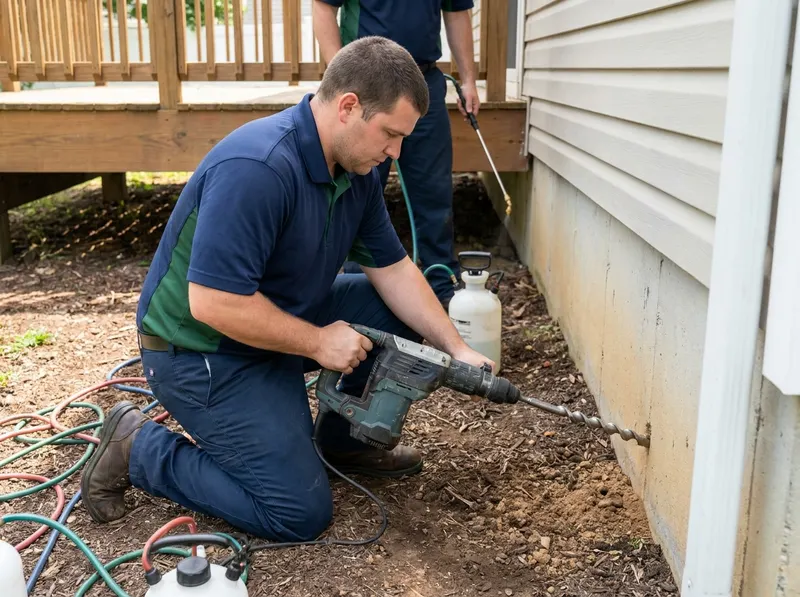
Subterranean termite infestations in Northern Delaware originate underground, where colonies travel through protective mud tubes along masonry footings to access structural joists. Historic brick foundations along Brandywine Village and Quaker Hill frequently feature stone rubblestone walls and damp basement dirt floors that invite subterranean workers. Modern slab-on-grade homes near the Riverfront face separate risks from plumbing penetration gaps, where termites bypass concrete through expansion joints as narrow as 1/32 of an inch. A comprehensive application pairs precise non-repellent liquid termiticides, such as fipronil, with exterior monitoring stations placed at 10- to 15-foot intervals. Worker termites unknowingly track the undetectable formula back to the central subterranean brood chamber, neutralizing the reproductive queen without requiring chemical aerosolization inside living spaces.
Selecting a perimeter soil trenching system over isolated localized foam injections depends entirely on foundation geometry and structural access. A localized foam injection addresses an active wall void inside a historic Highlands or Forty Acres rowhouse without drilling exterior flagstone, yet it leaves the subterranean ground colony intact outside. Conversely, a complete trench-and-rod barrier treatment saturates the exterior soil perimeter down to the top of the footing, typically 4 gallons per 10 linear feet per foot of depth, creating an unbroken perimeter shield. The functional trade-off balances immediate spot control against long-term structural exclusion: targeted spot treatments carry lower initial costs but require ongoing perimeter monitoring, whereas complete continuous barriers secure the entire structural envelope against subterranean return.
Ground moisture profiles across Wawaset Park, Cool Spring, and Trolley Square accelerate termite exploration due to mature tree canopies, aging root systems, and proximity to the Brandywine Creek basin. Property owners can schedule an assessment through a standard diagnostic visit by contacting (302) 551-3589 or providing foundation photographs for preliminary structural review.
Every job gets a firm, written price after a free on-site visit.
Tell us about your subterranean termite treatment job in Wilmington and we'll send a clear, written quote, usually the same day.
 Tavren Exterminators